Appliance Repair Content Marketing Strategy: Become Your Area’s Go-To Expert
A complete content marketing playbook built for appliance repair businesses. Learn how to answer the questions your customers are already Googling, create hyper-local content that dominates search results, and turn one piece of content into five marketing assets.
1Stop Selling Services — Start Answering Questions
Most appliance repair websites read like a menu: "We fix refrigerators. We fix washers. We fix dryers. Call us." That’s not content marketing. That’s a brochure. And brochures don’t rank on Google.
Here’s what your future customers are actually typing into search right now:
- "Refrigerator making clicking noise"
- "Should I repair or replace my dishwasher"
- "How long do washing machines last"
- "Samsung ice maker not working"
- "Dryer takes two cycles to dry clothes"
- "GE oven error code F97"
- "Burning smell from dryer"
These are real questions from real people with real problems. When you answer them clearly and helpfully, two things happen:
- Google starts showing your website to everyone in your area searching for those answers
- The person reading your answer already trusts you before they ever pick up the phone
Think of every blog post as a 24/7 employee who answers the phone, builds trust, and books the call — for free.
How to Find Questions Worth Answering
- Check your call logs. What do customers ask your front desk every single day? Those questions are content gold.
- Read your Google reviews. Customers describe their problems in their own words. Use that language.
- Search Google yourself. Type "refrigerator" and look at the "People Also Ask" section. That’s a free content plan.
- Ask your technicians. They hear the same questions in the field over and over. Write those down.
The Format That Works Best
Keep your answers simple and structured:
| Element | Why It Works |
|---|---|
| Clear headline matching the search query | Google can match it to searches |
| Short intro acknowledging the problem | Reader feels understood |
| Numbered steps or bullet points | Easy to scan on a phone |
| A "when to call a pro" section | Naturally leads to your phone number |
You don’t need to be a great writer. You just need to answer honestly. If someone searches "Samsung refrigerator not cooling," write the answer the way your best technician would explain it at the kitchen table. That’s the content that wins.
For more on how answering questions builds your search rankings, see our SEO guide.
2Hyper-Local "Neighborhood Showcase" Content
Generic content like "5 Signs Your Fridge Needs Repair" exists on thousands of websites. You can’t outrank national publishers with generic advice. But here’s what they can’t write: content about your town, your neighborhoods, and your actual customers.
The Neighborhood Showcase Formula
Write short stories about real jobs you’ve completed (with customer permission) that tie your work to a specific local area. For example:
- "We Just Saved a 15-Year-Old Sub-Zero in Lakewood — Here’s Why These Units Are Worth Repairing"
- "Emergency Refrigerator Rescue in Oak Park: How We Saved $400 Worth of Groceries on a Sunday"
- "The Kirkwood Dryer That Almost Caused a Fire — Why Vent Cleaning Matters"
- "Downtown Condo Living: Why Your Bosch Dishwasher Needs a Specialist"
Notice how each headline includes a neighborhood name, a specific appliance or brand, and a compelling outcome. This hits three search signals at once: local relevance, brand-specific expertise, and a reason to click.
Why This Works So Well
- Google prioritizes local content for local searches. A post mentioning "Maplewood" ranks for searches in Maplewood.
- Customers see their own neighborhood and immediately feel like you’re their local shop, not some faceless company.
- Each post builds your brand story. Over time, your website becomes a map of happy customers across your service area.
How to Write One in 30 Minutes
- Pick a recent job that had a good outcome
- Write 300–400 words: what was wrong, what you did, why it mattered to the customer
- Include the neighborhood or city name in the title and at least twice in the body
- Add a photo of the appliance (even a simple phone photo works)
- End with a line like: "Need refrigerator repair in [Neighborhood]? Call us for same-day service."
One neighborhood showcase post per week gives you over 50 hyper-local pages in a year. That’s a local SEO advantage most competitors will never match.
This approach pairs perfectly with your Google Maps listing to dominate local search results.
3Visual Content Strategies for Appliance Repair
Appliance repair is one of the most visual trades out there. You’re taking apart machines, replacing parts, cleaning hidden components, and transforming broken appliances into working ones. That’s content gold — if you capture it.
Before-and-After Photos
The simplest visual content you can create:
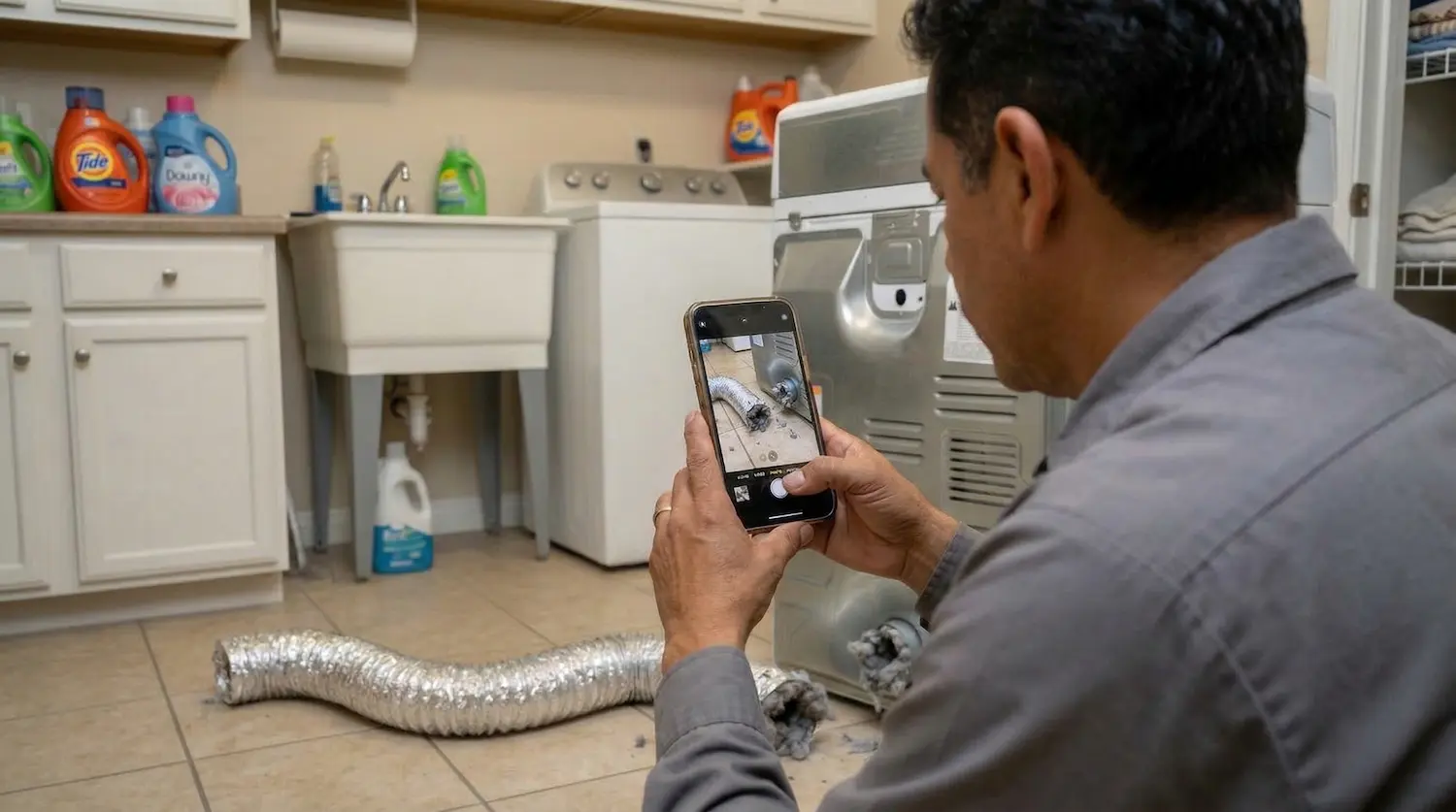
- Clogged dryer vents vs. clean ones — dramatic and shareable
- Dirty refrigerator coils vs. cleaned coils — shows the hidden problem
- Corroded dishwasher spray arms vs. new ones — explains poor cleaning performance
- Burned-out oven elements vs. replacements — makes the repair tangible
- Lint-packed dryer ducts — fire safety content that gets shared
Before-and-after photos work because they tell a complete story in two images. The customer sees the problem and the solution without reading a single word.
Short Video Content That Builds Trust
You don’t need a film crew. A phone propped up on the counter is enough for:
- "What’s inside your broken dryer" — pull out the lint buildup and show why it stopped heating
- "Why your ice maker stopped working" — 60-second explanation while pointing at the frozen water line
- Quick diagnostic walkthroughs — "Here’s how I figured out your dishwasher’s drain pump was failing"
- Parts comparison videos — hold up the old part next to the new one and explain the difference
Appliance Age and Condition Assessments
This is an underused content type that customers love:
- Photograph the model tag on an appliance and explain what the manufacture date means
- Show wear patterns that indicate an appliance is nearing end of life
- Create simple visual guides: "Your washing machine is telling you something — here’s how to read the signs"
Tips for Better Visual Content
- Natural lighting beats flash every time — pull the appliance away from the wall if needed
- Steady hands or a cheap tripod make videos look professional
- Talk while you work. Narrate what you’re doing in plain language. Customers love watching someone who clearly knows their craft.
- Always get permission before photographing or filming in a customer’s home
- Add captions to videos — most people watch with the sound off on social media
A single photo of a lint-clogged dryer vent with the caption "This is why your dryer takes 3 cycles" will outperform any polished marketing graphic you could design.
4Becoming the Local Authority on Appliance Decisions
Your customers face a stressful question almost every time an appliance breaks: should I repair this or buy a new one? If you become the trusted source for that answer, you’ll never run out of customers.
Repair vs. Replace Guides by Appliance Type
Create a dedicated page or blog post for each major appliance:
- Refrigerators: "If your fridge is under 8 years old and the compressor is still good, repair is usually worth it. Over 12 years with a compressor failure? Time to replace."
- Washing Machines: "Front-loaders often develop bearing issues around year 7–9. If the drum bearings go, the repair can approach the cost of a new machine."
- Dishwashers: "Most dishwashers last 8–10 years. A pump or motor replacement on a 9-year-old unit usually isn’t the best investment."
- Dryers: "Dryers are mechanically simpler than washers. A heating element or belt replacement is almost always worth it, even on older units."
- Ovens and Ranges: "Gas ranges can last over 15 years. A new igniter or control board is a smart repair on most units."
The general guideline: if the repair costs more than half the price of a new appliance, replacement usually makes more sense. But age and brand reliability matter too.
Brand Reliability Content
Your technicians see patterns that consumers never will. Share that knowledge:
- Which brands tend to last the longest in each appliance category
- Which brands have the most affordable replacement parts
- Which brands are difficult to get parts for (driving up repair costs and wait times)
- Which newer brands are showing early reliability problems
Be honest but fair. Don’t trash brands — just share what you see in the field. Customers respect transparency, and this kind of content gets shared widely.
Seasonal Maintenance Checklists
Publish timely guides that keep your business top of mind:
| Season | Content Topic |
|---|---|
| Spring | Washing machine hose inspection, refrigerator coil cleaning |
| Summer | Refrigerator and freezer prep for hot weather, ice maker maintenance |
| Fall | Dryer vent cleaning before heavy use season, oven checkup before holidays |
| Winter | Garbage disposal care during holiday cooking, dishwasher maintenance |
These checklists naturally lead to booking maintenance calls. They also make excellent material for your review request strategy — a customer who books a maintenance visit is a happy customer likely to leave a great review.
5The Content Distribution Rule: 1 Piece → 5 Channels
The biggest mistake appliance repair companies make with content isn’t creating bad content. It’s creating good content and only putting it in one place. Every piece of content you create should appear in at least five channels.
The 1-to-5 Framework
Start with one blog post on your website. Then distribute it:
Channel 1: Your Website Blog This is home base. The full article lives here with proper headings, photos, and a call-to-action. This is what Google indexes and ranks.
Channel 2: Google Business Profile Post Take the key takeaway from your blog post and write a 150-word Google Business post. Include a photo and a link back to the full article. Google Business posts show up directly in search results and Maps.
Channel 3: Instagram or Facebook Reel/Post Turn the core tip into a 30–60 second video or a photo carousel. For example, a blog post about dryer vent cleaning becomes a short video showing the lint buildup you pulled out of a vent that day.
Channel 4: Nextdoor Post Nextdoor is where homeowners go for local service recommendations. Share a helpful tip from your article in the neighborhood feed. Keep it genuinely helpful — not salesy. "Hey neighbors — quick reminder to check your dryer vents before winter. Here’s what we pulled out of a vent in [Neighborhood] this week."
Channel 5: Email to Past Customers Send a brief email with the article’s main point to your customer list. Past customers are your best source of repeat business and referrals. A seasonal maintenance reminder email keeps you top of mind.
Why This Multiplier Matters
- One blog post reaches people searching Google
- The Google Business post reaches people already looking at your listing
- The social media post reaches people scrolling their feed
- The Nextdoor post reaches your actual neighbors
- The email reaches people who already trust you
Writing one piece of content takes effort. Redistributing it across five channels takes about 30 extra minutes. That’s the difference between content that works and content that sits on your website collecting dust.
Keep a Simple Tracking Sheet
| Blog Post Title | Published | GBP Post | Social | Nextdoor | |
|---|---|---|---|---|---|
| Dryer Vent Safety | Mar 3 | ✓ | ✓ | ✓ | ✓ |
| Fridge Not Cooling | Mar 10 | ✓ | ✓ | Pending | ✓ |
This ensures nothing falls through the cracks. Most businesses that do this consistently see steady increases in website traffic and phone calls within the first few months.
6Your 90-Day Content Launch Plan
Here’s a week-by-week plan to go from zero content to a fully running content engine for your appliance repair business. Each week has one primary task. Don’t try to do everything at once.
Month 1: Foundation (Weeks 1–4)
Week 1 — Set Up Your Blog and Content Calendar
- Add a blog section to your website
- List 12 questions your customers ask most often — these are your first 12 topics
- Set a publishing schedule: one post per week
Week 2 — Write Your First "Common Question" Post
- Pick the question you hear most (e.g., "Why is my refrigerator not cooling?")
- Write 400–600 words answering it clearly with a photo
- Distribute to all 5 channels
Week 3 — Write Your First Neighborhood Showcase
- Pick a recent job with a great outcome in a specific neighborhood
- Include a photo of the appliance and distribute to all 5 channels
Week 4 — Create Your First Visual Content
- Take before-and-after photos on your next three service calls
- Post one set to social media and start building a photo library
Month 2: Momentum (Weeks 5–8)
Week 5 — Write a Repair vs. Replace Guide
- Start with refrigerators — cover age ranges, common failures, and when replacement makes sense
Week 6 — Write a Seasonal Maintenance Post
- Write the maintenance checklist for the upcoming season — great email content for past customers
Week 7 — Create a Short Video
- Film a 60-second repair explanation on a job (with permission) and post to social media
Week 8 — Write a Brand-Specific Post
- Pick the brand you service most (Samsung, Whirlpool, LG) and cover common issues
Month 3: Authority (Weeks 9–12)
Week 9 — Write a "Warning Signs" Post
- "5 sounds your refrigerator makes and what they mean" — high-search-volume, shareable content
Week 10 — Publish a Second Neighborhood Showcase
- Different neighborhood, different appliance type
Week 11 — Create an Emergency Preparedness Post
- "What to do when your refrigerator stops working at midnight" — ranks well for emergency-related searches
Week 12 — Review and Plan Next Quarter
- Check which posts drove the most traffic and calls, double down on what works, and plan 12 more topics
After 90 days, you’ll have at least 10 pieces of content working for you around the clock. Most competitors will still have a static website with zero helpful content. That’s your advantage.